

Did you know a modest build can save nearly $200 compared with store prices while adding custom function to your living area?
You’ll build a hinged‑lid storage piece that keeps blankets and remotes neat and matches your room’s clean, modern lines.
This guide shows the practical plans to move from idea to finished project. You’ll work with 3/4″ PureBond oak plywood and solid oak trim, assemble with pocket screws and glue, and add a glued, countersunk bottom for strength.
Learn why edge banding matters on stain‑grade plywood, how to route trim, and how to mortise torsion hinges with a 1/2″ bit and a jig for safe, held‑open motion. The finish uses ZAR Moorish Teak and three coats of water‑based polyurethane, and one example ran about $193 for materials.
Key Takeaways
- Clear sequence: from planning and wood selection to final finish.
- Hardware tips: torsion hinges mortised and aligned for safe lid action.
- Material note: PureBond oak plywood, oak trim, pocket screws, and edge banding give a stain‑grade result.
- Tools list: router, pocket hole jig, brad nailer, straight bit, and hinge jig make assembly clean.
- Budget & time: expect modest material costs and a predictable build timeline.
What You’ll Build Today and Why It Works in a Modern Living Room
You’ll create a low-profile centerpiece that blends clean edges and warm grain for modern rooms.
What the build is: a storage coffee table built from 3/4″ PureBond oak plywood and solid oak trim. The design pairs a sleek top and crisp sides so the piece reads like custom furniture rather than a bulky box.

The finish uses ZAR Moorish Teak and three coats of water-based polyurethane for a durable, modern sheen. Hidden fasteners and neat trim let the exterior read as one continuous surface.
- You get practical dimensions: low height, roomy interior, and a top sized for trays, books, and daily use.
- Plans use simple joinery and pocket screws so first-time projects build with confidence.
- The core plywood plus solid trim keeps the piece stable across seasons while showing real wood grain.
- Hardware choices—torsion-style motion for the lid—make opening feel refined and reliable.
These plans are easy to adapt to your room footprint. Tweak the overall dimensions without changing the structure and keep the clean, modern silhouette that complements streamlined sofas and chairs.
Tools, Materials, and Hardware You’ll Need
Gathering the right materials and tools up front saves time and prevents costly mistakes during the build.
Stock the essentials so each step flows. Start with 3/4″ PureBond oak plywood and matching solid oak trim. Add plywood edge banding, quality screws, wood glue, and wood filler. Keep ZAR Moorish Teak stain and a water‑based polyurethane on hand for the finish.

Core materials
- 3/4″ plywood for the case and matching solid trim for faces.
- Edge banding and a trimmer to hide plywood edges.
- Screws, nails, wood glue, and wood filler to secure and finish surfaces.
Essential tools
- Cutting & shaping: table saw, miter saw, circular saw for sheet breakdown, jigsaw as needed.
- Joinery & fasteners: pocket hole jig for pocket holes, drill with self‑centering bit, router with a 1/2″ straight bit and round‑over bit.
- Finishing & setup: 18‑gauge brad nailer, sander, clamps, right‑angle fences, and a shop vacuum.
Smart hardware picks
Choose torsion hinges for a refined lid action that holds position. Use a piano hinge if you prefer a continuous, simple mount that needs no mortising.
| Hardware | Use case | Note |
|---|---|---|
| Torsion hinge | Premium lid control | Requires mortise with a router bit |
| Piano hinge | Simpler attachment | No mortising; visible seam |
| Drawer slides & angle brackets | Optional cubby or securing top | Pick sizes that match opening |
“A self‑centering bit is a small investment that makes hinge installation fast and accurate.”
Plan Your Build: Dimensions, Storage Style, and Room Fit
Begin with the table’s footprint: size dictates storage capacity and visual balance.
Standard and large size options to match your space
Standard: 47″ W x 27″ D x 16″ H fits most seating arrangements and keeps reach comfortable.
Large: 60″ W x 36.25″ D x 16″ H works for sectionals and offers a generous top for trays and decor.
Choose your storage style
Pick the storage approach that matches daily use. A hinged‑lid chest maximizes room for blankets and larger items.
An added shelf gives quick‑grab access and a finished underside when set on cove molding cleats.
A center drawer cubby uses slides and a false front to hide remotes and small items near the bottom.
- Map seating distance to each side and adjust the plans proportionally to keep circulation clear.
- Sketch a short list of what you’ll store to set interior clearance and where the bottom sits.
- Confirm plywood yields and planned cuts for your boards to avoid visible holes in finish areas.
“Reduce width before depth if space is tight; it preserves top usability while keeping scale right.”
Create Your Cut List and Prep Your Boards
Before you touch a blade, translate overall dimensions into a clear, numbered cut list.
Cut list fundamentals for box parts
Draft a cut list that names box sides, bottom, lid, trim pieces, stretchers, and any legs. Confirm each dimension twice before cutting.
Break down sheets with a circular saw and straightedge, then finish rips on a table saw for square ends. Use a miter saw for repeatable crosscuts and label pieces as you go.
Edge banding prep for stain‑grade panels
Band edges that will show when the lid opens or inside compartments. Apply heat‑activated edge before assembly, trim flush, then do light sanding for a smooth join.
Pocket hole layout for clean assembly
Lay out pocket holes on faces that will be hidden by exterior trim. Mark hole spacing and dry fit parts so screws don’t clash with later fasteners.

| Tool | Best use | Why |
|---|---|---|
| Circular saw | Sheet breakdown | Safe, fast cuts with a straightedge |
| Table saw | Final rips | Accurate edges and square panels |
| Miter saw | Crosscuts | Consistent short pieces and trim |
“Confirm dimensions twice and label parts to avoid wasted boards.”
Build the Core: Box Body, Bottom Panel, and Exterior Trim
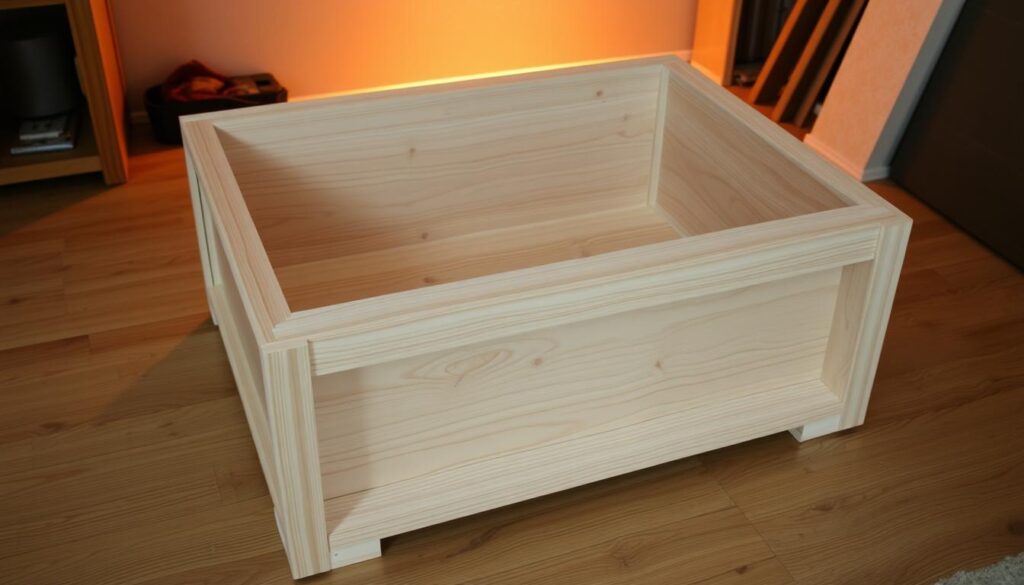
Set up your right-angle fences and clamps, then align the box panels for a tight, furniture-grade join.
Assemble the case
Dry fit the four panels and confirm each side meets square. Check diagonals and adjust clamps until corners close without gaps.
Glue joints lightly, then drive pocket holes and screws while the right-angle fences hold faces aligned. Wipe glue squeeze-out immediately with a damp cloth.
Install the bottom and add trim
Spread glue evenly on the bottom edge and set the bottom panel in place. Use countersunk screws from the outside so the interior stays clean for a furniture finish.
Edge band top-visible board edges before assembly to save sanding later. Rip and rout trim profiles on the router and cut 45° miters on a dedicated sled on the saw for repeatable accuracy.
- Attach trim with a thin bead of glue and a few brad nails; fill nail heads and tiny gaps with wood filler.
- Keep the back line straight where hinges will mount later; avoid build-up that interferes with hardware.
| Task | Tool | Why it matters |
|---|---|---|
| Panel alignment | Right-angle fence & clamps | Prevents twist and ensures square diagonals |
| Bottom installation | Drill & countersink | Keeps interior free of visible fasteners |
| Trim mitering | 45° sled on saw | Tight, repeatable corner fits |
“Check diagonals and re-square before glue sets; small clamp moves now save major fixes later.”
DIY Coffee Table With Storage Plans: Step‑By‑Step Blueprints for the Lid and Hinges
A well-mounted lid transforms a box into useful furniture—focus on hinge choice and precise alignment for smooth action.

Hinge choices: torsion vs piano
Choose torsion hinges if you want the lid to hold at any open position and avoid slamming. They feel premium and protect fingers.
A piano hinge is a simple alternative that mounts directly to the top edge and underside of the lid. It requires no mortising and gives continuous support, though it is more visible.
Mortising and routing for torsion hardware
If exterior trim thickens the back edge to about 1‑1/2″, you should mortise the hinge pockets so the hardware sits flush.
Use a router with a sharp 1/2″ straight bit and guide fences for clean, repeatable cuts. A steady fence prevents wandering and keeps the pocket depth uniform.
Cut, align, and attach the lid
Size and cut the lid, then test the top overhang to ensure a crisp reveal. Keep the edge consistent from front to back so the motion looks intentional.
Use a torsion hinge jig to mark and predrill holes. A self‑centering bit keeps screws true so the lid does not shift over time.
- Set the jig for overlay or flush mounting so screw placement is exact and the gap stays even.
- Dry‑fit hardware and check that the lid clears the back trim throughout travel.
- Drive fasteners by hand and snug each hole in sequence while checking motion across the top.
“Careful routing, precise predrilling, and patient alignment give you a perfect lid that feels great every time you open it.”
| Hinge type | Pros | Cons |
|---|---|---|
| Torsion hinge | Holds position, prevents slams | Requires mortising and precise routing |
| Piano hinge | Simple install, continuous support | Visible seam; may bind if edges aren’t flush |
| Installation tip | Use a torsion jig and 1/2″ bit | Pretest clearance with lid closed and open |
Optional Add‑Ons: Lower Shelf and Center Drawer Cubby
Consider adding a lower shelf and a centered cubby to increase usable storage without changing the external lines.
Under‑shelf and finished underside
Install cove molding as cleats under the stretchers so the shelf panel sits flush and every side has support.
Cut the shelf to a tight fit using a circular saw and a straightedge. Run a generous bead of glue along the cleats so the pieces bond firmly to the trim and stretchers.
Center cubby and drawer basics
For the center cubby, use 3/4″ plywood sides notched around the top stretchers so the cubby locks into the frame.
Edge band the exposed plywood at the opening so the grain reads continuous, then secure the cubby with a few pocket holes on inside faces and the bottom.
- Dress the cubby face with tapered molding as trim; miter each corner and press joints tight so reveals are even.
- Build simple drawers from 1/2″ sides and 1/4″ bottoms, mount slides per spec, and fit false fronts from 1x boards with about a 1/8″ gap all around.
- If you mount the top separately, use furniture angle brackets inside the frame so no fasteners show externally. Keep screws short enough to avoid penetrating the top and measure twice before driving.
“These add‑ons let you tailor storage for devices and accessories without altering the clean profile.”
| Feature | Material | Tip |
|---|---|---|
| Lower shelf | plywood, cove molding cleats | Glue and tight fit; supports on every side |
| Center cubby | 3/4″ plywood, tapered trim | Notch sides, edge band, secure with pocket holes |
| Drawers | 1/2″ sides, 1/4″ bottoms, 1x fronts | Use slides; leave 1/8″ reveal; adjust for parallel motion |
Sanding, Stain, and Protective Finish
A careful sanding routine makes the stain pop and the protective coats last longer.
Start by filling brad nail holes and any small gaps with wood filler. Sand progressively from 120 to 220 grit so surfaces feel even. Break sharp corners slightly so the top and edges are pleasant to touch.
Smooth, fill, and round over for stain‑grade results
Use a router with a small roundover bit on the top perimeter to soften contact points while keeping a crisp profile. Verify edge banding is flush on plywood ends before staining.
Wipe dust from the whole piece, including the bottom and under trims. A clean surface helps the finish lay down evenly and avoids nibs or drag marks.
Stain choices and clear coats for durable living‑room use
Apply ZAR Moorish Teak for a warm, consistent tone that complements most furniture. Wipe back in time and allow full dry before clear coats.
Protect the surface with three coats of water‑based polyurethane. Lightly sand between coats to remove raised grain and keep the surface smooth. Let the piece cure before heavy use.
| Step | Tool | Why it matters |
|---|---|---|
| Fill & sand | Sander, 120–220 grit | Removes defects and evens pores for better stain |
| Roundover edge | Router + small roundover bit | Softens touch points, preserves modern profile |
| Stain & seal | Cloth, brush, water‑based poly | ZAR Moorish Teak + three coats for living room durability |
“Inspect under bright light for missed spots and spot‑sand if needed.”
Build Time, Cost, and Pro Tips for Success
Estimate active work and dry times so you hit finish day with confidence.
Typical timeline
Plan your time in stages: half a day to break down stock and complete the cut list.
Expect another half day to assemble the box and bottom, then half a day for trim and hardware prep.
Reserve a final day for staining and protective coats, accounting for drying between coats.
Budget snapshot and smart tricks
Budget note: one recent build landed near $193 for two plywood sheets, stain, hinges, and knobs when you already had some oak on hand.
Angle brackets can secure the top from beneath if you prefer hidden fasteners.
“A two‑minute check of your plans at each stage can save an hour of correction later.”
- Use right‑angle fences and clamps to keep panels plumb while driving screws; it’s the fastest way to improve accuracy.
- Predrill hinge holes with a self‑centering bit and employ a multi‑stand to support the lid during install.
- Batch similar cuts, label parts, and sort screws by length to avoid errors and rework.
- Dry fit the shelf or cubby; a tight fit should still slide in without bruising an edge.
- Sanding between finish coats is a quick way to elevate results and even the sheen.
| Item | Typical time | Why it helps |
|---|---|---|
| Cut list & breakdown | 0.5 day | Reduces waste and speeds assembly |
| Box assembly & bottom | 0.5 day | Core structure set before trim |
| Trim & hardware | 0.5 day | Ensures alignment for hinges and edges |
| Finish & cure | 1 day (plus dry) | Proper drying improves durability |
Revisit your plans often and work in focused bursts. This way you keep progress steady and avoid the common pitfalls that slow projects down.
Conclusion
This final note sums how practical joinery and careful finish turn raw boards into useful living‑room furniture.
Use the plans you followed to keep each move deliberate. From breaking down stock to aligning the back trim and mortising torsion hinges with a 1/2″ bit, the project links simple tasks into a polished result.
You now know the best way to set the lid, rout trim, and protect the top with stain and poly. Whether you build a diy coffee table or choose a piano hinge, the pieces lock together to feel like quality furniture.
Keep notes, reuse offcuts, and adapt these plans to fit another room when you want a matched set.