
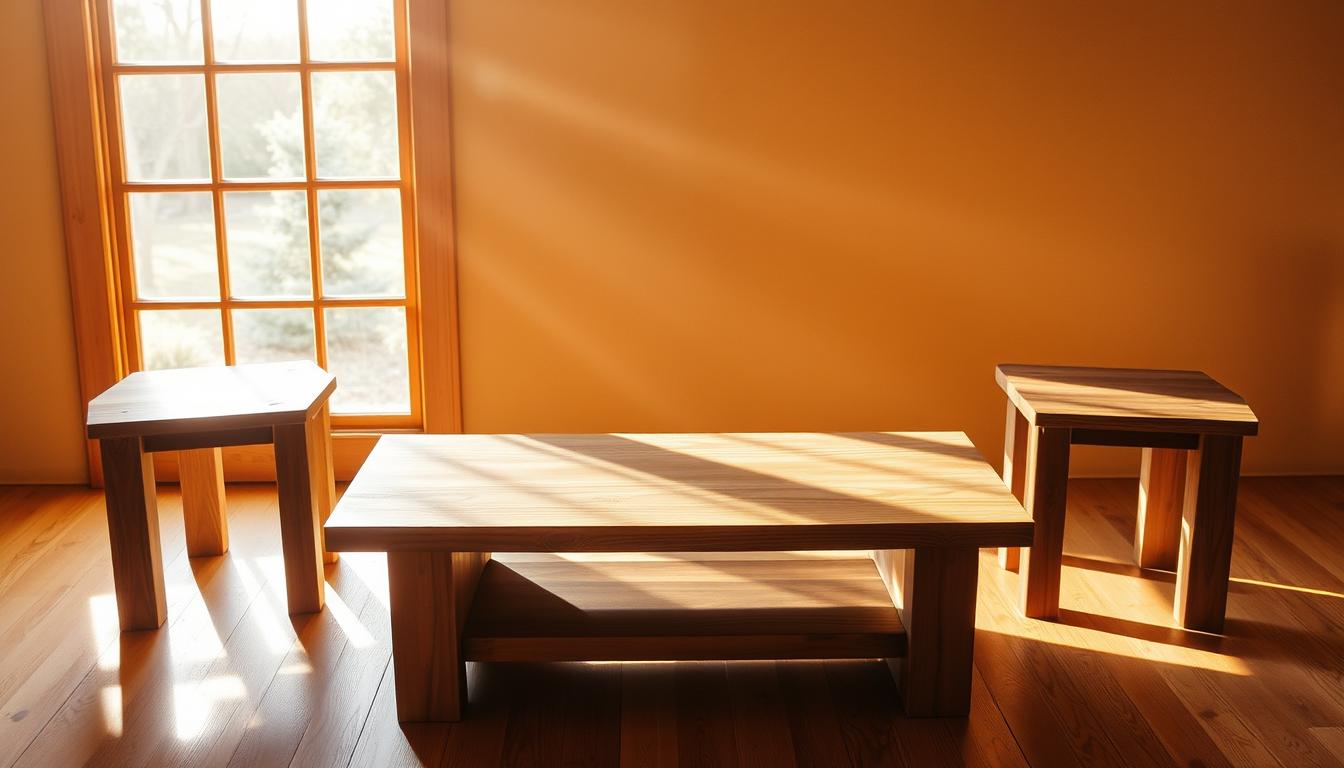
Surprising fact: nearly 70% of homeowners save over $150 by making their own living room furniture using basic stock lumber and simple tools.
This project walks you through a full weekend plan to make a cohesive coffee table and matching end pieces that suit most living rooms. You’ll follow clear plans that list tools—table saw, miter saw, drill, brad nailer, pocket hole jig—and materials like pine, cedar, screws, stain, and polyurethane.
The guide shows two proven design routes: a farmhouse frame with patterned cedar tops and painted bases, or a modern set with poplar bases and alder tops sized to fit common seating. Expect step-by-step cuts, rabbets, joinery tips, and a router or flush-trim option for clean edges.
Practical perks: standard height guidance (16–18 inches), a three-day timeline option, and a budget-friendly parts list so your final finish is both durable and stylish. You’ll leave with confidence to assemble, sand, stain, and protect a set that fits your space.
Key Takeaways
- Follow a clear plan that covers tools, cut lists, joinery, assembly, and finishes.
- Choose between farmhouse or modern design based on material and finish tips.
- Stick to recommended heights (16–18″) and standard footprints for comfort.
- Use pocket holes or dowels, clamp square, and finish with stain plus polyurethane.
- Budget smart: save on softwoods, splurge on hardwood tops for longevity.
Why build your own matching coffee table and end tables
Making a hand-crafted set gives you control over fit, finish, and cost in a way store options rarely match. You pick the footprint, choose stain or paint, and align hardware to the rest of your home for a cohesive look.
Smart savings are real: recent builds using poplar and alder report about $75 for a coffee table and $30 for an end table. Many hobbyists finish both pieces in roughly three days by sequencing cuts, assembly, and dry times.
Practical perks include building to the ideal height (typically 16–18 inches) so the table feels comfortable from your sofa. Solid joinery—pocket screws or dowels—plus a robust finish creates durable pieces that stand up to daily use.
- Control look, size, and finish instead of compromising.
- Match stain and hardware to existing furniture for a unified room.
- Gain repeatable skills—stock prep, squaring, and joinery—for future projects.
Adaptability is another win: round corners for kids, beef up tops for entertaining, or tweak proportions to fit an odd seating layout. The result is a personalized set that adds warmth and value to your home.
Plan your design, size, and style for your living room
Map the seating area first to ensure the finished pieces fit the room and leave natural walkways.
Start with measurements: leave 14–18 inches of walk space between seating and the table, and pick a table height in the 16–18 inches sweet spot for easy reach.

Choose dimensions that fit your seating layout
Measure sofa depth and arm height. Aim for end pieces within an inch or two of the arm so lamps and remotes sit at hand.
Modern, farmhouse, or minimalist: pick a cohesive style
For modern rooms, a compact 32.3 x 32.3 inches footprint works well. For longer sofas, consider 43–48 inches overall.
- Match widths to rug size and legroom so the top doesn’t crowd knees.
- Keep bases uniform; vary only top size for visual rhythm.
- Choose alder or walnut for refined looks, pine or cedar for farmhouse texture.
- Confirm layouts with painter’s tape before cutting boards.
Tools and materials you’ll need to start this DIY project
Start by lining up the shop essentials before cutting a single board. A small, organized kit speeds every step. Lay out safety gear first: eye and ear protection, dust mask, and a shop fan or dust collection if available.
Core power and hand tools
Essential tools: a table saw for ripping stock and a miter saw for accurate crosscuts. Add a drill/driver, a brad nailer, and a sander (orbital or belt).
Joinery helpers
Bring a pocket hole or dowel jig, clamps, and a reliable square for true frames. These make assembly fast and keep corners square.
Optional but useful items
A router with a flush-trim bit cleans up overhangs. A heat gun helps with paint distressing and a protractor aids angled braces. Keep a circular saw handy for panel breakdowns.
Lumber, fasteners, and finishes
Choose lumber by role: pine boards for economical frames, cedar 1×6 for patterned tops, poplar for paint-grade bases, and alder for stained tops. Consider hardwoods like oak for high-use pieces.
| Item | Common Sizes | Why it matters |
|---|---|---|
| Pine 2×2 / 2×4 | Prep to 1.5″ stock | Strong, low-cost frame material |
| Cedar 1×6 | Top planks | Distinct grain for patterned surfaces |
| Poplar / Alder | Bases and tops | Poplar for paint, alder for stain |
| Fasteners & finish | 2″ screws, 1¼” & 2″ brad nails | Choose lengths to avoid blow-through; stock glue, filler, stain, and poly |
Organize nails and screws by length to avoid mistakes. Inspect each board for straightness and knots before cutting. Good prep reduces waste and keeps the project on schedule.
DIY Coffee Table And End Tables: Matching Sets You Can Build
Set a clear weekend rhythm: prep, assemble, and finish in three focused days. Start by cutting and prepping stock on Friday night. This reduces weekday stress and lets glue joints cure overnight.
Saturday is for frame assembly and top glue-ups. Build the smaller frames first so the long rails keep the larger top surfaces level and accurate.
Sunday focuses on sanding, final trim, staining or painting, and poly coats with planned dry windows. Finish sequencing—stain first, paint bases during the top’s first poly cure, then final poly—saves time.
Budget snapshot: where to save and where to splurge
Use pine frames with cedar tops to save costs. If you want a paint-grade result, poplar is a smart economy choice. Splurge on hardwood tops like alder or walnut for lasting wear and heirloom appeal.
Typical material cost estimates: $75 for the coffee table and about $30 per end piece when using budget-friendly lumber and basic hardware.

- Batch parts for both pieces to speed cuts, drilling, and sanding.
- Use stop blocks and pre-sand parts to reduce hand work later.
- Add shelves or X-braces for stiffness and storage as optional upgrades.
| Task | When | Why it helps |
|---|---|---|
| Cut & prep stock | Friday night | Speeds weekend assembly; allows inspection of boards |
| Frame assembly & tops | Saturday | Build end frames first for accurate alignment |
| Sanding & finishing | Sunday | Stagger coats to allow cure time and minimize rework |
Cut lists and sizing for coffee table and end tables
Start by laying out exact cut lengths so each component nests together without guesswork.
Coffee table frame and top: use square stock ripped to 1.5″ from 2x4s. Cut legs 4 @ 19 inches (1.5″ x 1.5″). Make rails and stretchers: 2 @ 32″ (1.5″ x 1.5″), 2 @ 32″ (1.5″ x 2″), 5 @ 44″ (1.5″ x 1.5″), and 2 @ 44″ (1.5″ x 2″). Target finished overall: 14.6 inches high by 32.3 inches wide and deep for a compact footprint.
End table frame and top: legs 4 @ 23 inches. Cut rails: 3 @ 21″ (1.5″ x 1.5″), 2 @ 21″ (1.5″ x 2″), plus 2 @ 19″ (1.5″ x 1.5″) and 2 @ 19″ (1.5″ x 2″) for shelf supports.
Use a clamped stop block on the miter saw fence for repeatable lengths. Square edges by shaving factory bevels so boards meet flush. Dry-fit all pieces, label parts, and reserve offcuts for test joints.
| Component | Cut list | Profile / notes |
|---|---|---|
| Coffee legs | 4 × 19″ | 1.5″ × 1.5″ square stock |
| Coffee rails & stretchers | 2 × 32″, 2 × 32″, 5 × 44″, 2 × 44″ | Mix of 1.5″×1.5″ and 1.5″×2″ for strength |
| End table rails & supports | 3 × 21″, 2 × 21″, 2 × 19″, 2 × 19″ | Thicker pieces for shelf rabbets and load |
Prepare your boards: rip, square, and sand before assembly
Prep your lumber precisely: remove factory bevels, rip to final sizes, and mark the best face for visible grain. This early organization makes glue-ups faster and reduces rework.
Rip 2x4s to 1.5-inch stock and square edges
Set the table saw fence to cut 2x4s down to true 1.5-inch stock after trimming beveled edges. Do the same for 2x6s, ripping them to 2-inch rails for shelf rabbets.
Use featherboards, push sticks, and a splitter or riving knife for safe, accurate rips. Check thickness on each piece to avoid proud joints or twist when frames are clamped.
Initial sanding strategy to save time later
Mark and stage each board so the cleaner face shows on finished surfaces and hidden faces get pocket holes or dowels. Complete an initial pass with 80-grit on all faces to knock down mill glaze and reach areas that will be hard to sand after assembly.
Joint edges with a light table-saw cleanup or hand plane for tight glued seams. Pre-round sharp arrises that won’t receive trim to reduce chipping and ease finishing.
“Good prep is the step that makes assembly feel effortless.”
Organize parts by sub-assembly—ends vs long rails—and keep offcuts to test stain on the same species (pine or chosen hardwood) before the final finish.

Joinery choices: pocket screws, dowels, or both
Choose a joinery strategy that balances hidden strength with clean sightlines. For most frames, pocket holes give fast clamping force and predictable alignment. Dowels deliver a fully concealed joint that sands smooth for paint-grade finishes.
Where to place pocket holes for hidden strength
- Drill pocket holes in rails and stretchers, keeping them on the least-visible faces so the assembled piece shows clean lines.
- Avoid pocket holes in legs; keep those faces smooth for stain or paint and to preserve structural integrity.
- Put pocket holes toward the underside of tops and shelves so the presentation face stays pristine.
Dowel alignment tips for clean, paint-grade joints
Use a dowel jig if you want completely hidden joinery. Confirm hole spacing and dowel depth so fasteners never telegraph through thin rails.
Always apply quality wood glue to mating surfaces and clamp firmly. Screws act as clamps, but pressure from clamps improves long-term stability and prevents gaps.
Assemble on a flat surface and check for square after each step. Pre-drill near ends to prevent splitting in softwoods, and wipe away squeeze-out before it dries to avoid finish problems later.
| Method | Best use | Key tip |
|---|---|---|
| Pocket screws | Fast assembly, hidden undersides | Keep on blemished faces; clamp while driving |
| Dowels | Paint-grade, smooth surfaces | Use a jig and test dowel depth |
| Both | Extra strength where needed | Glue all joints; stagger fasteners |
Assemble the frames: legs, rails, and rock-solid corners
Start assembly by making two identical end frames first. These sub-assemblies become the reference that keeps the whole unit square and level.
Build end assemblies first for accuracy
Set the short 1.5″×1.5″ rails flush with the tops of the legs so the top plane is consistent. Install the 1.5″×2″ lower rails 3 inches above the bottom for shelf clearance.
Clamp, square, and fasten long rails to keep tops level
Use corner clamps or a reliable square and verify 90 degrees before fastening. Fasten long rails on a flat bench to avoid twist and check diagonals for equal measurements.
- Fastening: use glue plus screws or brads to hold joints while the adhesive cures.
- Top plane: keep joints flush at the top so the tabletop bonds to a level reference.
- Labeling: mark underside orientation so tops and trim align across all sides.
Add rubber feet and level out any wobble
Attach rubber washers to the feet with short screws, slightly countersinking heads to protect floors. Test the assembled unit on a hard surface and shim one foot with an extra washer if there is any wobble.

| Quick check | What to verify | Why it matters |
|---|---|---|
| Corners | Square at 90° | Prevents twist and keeps the top level |
| Rails | Flush at top plane | Ensures the tabletop seats evenly |
| Feet | Rubber washers & shim | Protects floors and removes wobble |
Final step: let the assembly rest while you pre-cut top components to keep the workflow efficient and avoid downtime.
Build the tabletops: plank, pattern, and flush-trim options
Start the top layout by scribing a centerline on the frame. Dry-fit cedar or 1x boards to balance grain and color before any glue touch. This prevents misalignment when you set the pattern.
Solid plank glue-ups use square edges ripped on the saw for tight joints. Apply glue to board edges and along rails, then fasten boards from below with 2″ brad nails so the show face stays clean.
Patterned tops: lay 45-degree cedar pieces from the centerline for a chevron or diamond look. Alternate smooth and rough faces for texture variation. Cut pieces 1/2″ long if you’ll use a flush-trim router bit.
Flush-trim and perimeter finish
Cut boards slightly long, then use a flush-trim router bit to remove overhang—this often takes about three minutes. Trim the mitered perimeter after flush-trimming or use a circular saw guided by a straightedge if you built the slab off the base.
“A careful dry-fit and focused trim make more difference than extra sanding later.”
- Check flatness and remove proud edges with a light hand plane before final sanding.
- Keep glue squeeze-out minimal to avoid stain issues; wipe excess promptly.
- Mark grain direction to sand uniformly and avoid swirl marks on the show surface.
| Option | Fasten | Trim method |
|---|---|---|
| Plank top | Glue + underside brad nails | Circular saw or router guide |
| 45° patterned top | Glue + brads from below | Flush-trim router then miter perimeter |
| Single slab glue-up | Clamps + glue; no top fasteners | Router flush-trim or guided saw cut |
Add shelves and support: cutting rabbets and installing slats
Plan the shelf placement before cutting so the final fit is accurate and visually clean. Mark the rail locations and confirm clearance for baskets or storage at the bottom of the unit.
Cut clean rabbets in the 1.5 × 2-inch rails with two passes on the table saw. Set the fence 1/2″ from the blade and raise the blade to the cedar board thickness for the first pass. For the second pass, set the fence to the board height (for example, 7/8″) and lower the blade to about 1/2″.
Measure and fit shelf slats
Trim the rabbet tails on shorter rails so corners sit tidy. Use a stop block to rip consistent widths for the boards and test-fit pieces until they sit snug and rattle-free.
- Glue and brad-nail shelves into the rabbets; choose nail length that won’t pierce the visible face if you will stain or paint.
- Keep shelves parallel to the top so sightlines are clean from the side.
- Sand edges lightly where hands touch and confirm the underside is smooth and free of sharp points.

| Step | Fence / Blade | Why |
|---|---|---|
| First pass | Fence 1/2″, blade = board thickness | Remove bulk material for rabbet shoulder |
| Second pass | Fence = board height(≈7/8″), blade ≈1/2″ | Set seat depth so slats sit flush |
| Short rail tails | Trim last 1/2″ | Clean corner fit and visual finish |
Edge trim and design accents: mitered trim and X-braces
Finish work sells the project: precise mitered trim and well-cut braces give a pro feel and tidy the perimeter for a clean look.
Rip and miter trim for a clean perimeter
Rip cedar trim to match the top thickness and cut 45° miters for crisp corners. Glue, clamp, then secure with 1-1/4″ brads so the edge sits flat and true.
Clamp the first piece, use a 45° scrap to register the opposite cut, and mark miters from the real assembly rather than trusting only fence measurements.
Lay out and cut accurate X-braces
Lay stock across the opening, mark intersections, and transfer those marks to each piece before cutting. Verify each angle with a digital protractor so the center joints meet without gaps.
Typical tested angle pairs: coffee example 20°/51° and end piece example 38.5°/13°. Dry-fit both pieces and mark intersection lines for clean trimming.
Pre-sand small parts to save time
Pre-sand X components and trim so you avoid tedious hand work in tight corners after installation. Keep nail placement toward inside faces to simplify filling and finishing.
Quick checks: align grain on the face, confirm the brace clears shelf space, and ensure it won’t catch feet in traffic.
| Task | Method | Why it matters |
|---|---|---|
| Trim rip & miter | Rip to thickness; 45° miters; glue + 1-1/4″ brads | Framed perimeter, tight corners |
| X-brace layout | Clamp, mark intersections, verify with digital protractor | Tight center joints; avoids gaps |
| Pre-sanding | Sand small parts before install | Saves hand sanding and gives cleaner finish |
Finishing system: stain, paint, and polyurethane that lasts
A reliable finish plan turns raw boards into heirloom-quality furniture. Start with clean surfaces to get even absorption and predictable color.
Stain schedule
Pre-treat by vacuuming dust, then wipe with mineral spirits. This evens the pore opening on the wood and prevents blotchiness.
Lay a base coat of Minwax Weathered Oak. Add selective Espresso accents and blend with mineral spirits to create depth. If the tone reads too dark after drying, sand back lightly with 220 to fine-tune.
Painted bases and distressing
Rub wax on edges and high-touch zones before painting to create a resist. Apply two coats of off-white latex. Use a heat gun to bubble the top layer, then scrape for authentic wear.
Protective coats and sanding
Fill nail holes with wood filler or Bondo for painted areas. Plane the top to level quickly, then sand cedar in this order: 80, 120, 220. Sand frames to 120 before primer.
- Brush 2–3 coats of polyurethane; spray a final coat on the top for a glassy finish.
- Sand with 220 between coats to remove nibs and improve adhesion.
- Finish the shelf with two brushed coats to resist scuffs and spills.
“Allow full dry times per product directions to avoid prints and lingering odor.”
Final tip: follow this step list for a consistent result and a lasting finish on your table during this diy project.
Time, cost, and skill considerations in the United States
A practical three-day rhythm keeps tasks small and gives finishes time to cure. Plan your weekend so cutting and frame assembly happen first, tops and trim on day two, and sanding plus poly on day three.
Weekend build plan and dry-time sequencing
Day 1: cut stock, rip to size, and assemble frames. Day 2: glue tops, add shelves, fit trim. Day 3: sand, stain or paint, then apply protective coats while respecting dry windows.
Typical material costs for pine, cedar, poplar, and alder
Budget route: pine frames with cedar tops are common and affordable at big-box stores. Midrange: poplar bases with alder tops—estimate about $75 for the coffee and $30 per end when you use existing stock.
When to choose hardwoods like oak or walnut
Pick oak or walnut if your household needs better dent resistance and a higher-end look. Factor consumables—blades, sandpaper, glue, filler, and finish—into totals and batch orders to reduce waste.
| Choice | Why | Cost note |
|---|---|---|
| Pine + cedar | Budget, forgiving finish | Lowest upfront |
| Poplar + alder | Paint/stain ready | Midrange |
| Oak/walnut | Durable, premium | Higher cost |
Practical tip: track receipts per piece, adapt plans to your tools, and choose the farmhouse route if you want forgiving finishes that hide wear while keeping long-term value in your home.
Style your new set: living room layout and decor ideas
Plan placement so the new pieces feel intentional, not accidental, in the space. Start by centering the coffee piece on the rug and aligning it with the sofa to create balance. Leave consistent walkways—about 14–18 inches—on all sides for flow.
Layer lighting by anchoring a lamp on a nearby side table at arm height. This gives even illumination and helps create zones for reading and conversation.
Pair with sofas, rugs, and lighting for balance
Offset heavy sofas with lighter-toned tops to keep the room airy. Echo metal finishes from lighting or hardware in small accents for a cohesive palette.
Use accessories like a tray, a stack of books, and a soft throw to add texture without clutter. Consider rounded decor if your piece has sharp lines to soften the look.
Finishing colors that complement modern or farmhouse rooms
For farmhouse style, choose off-white bases with weathered tops. For modern or minimalist rooms, pick gray or black bases paired with natural wood tops for contrast.
- Repeat a wood tone at least twice (top plus picture frames) to tie the room together.
- Place baskets on the shelf for neat storage of remotes and magazines.
- Reassess sightlines seated and standing to avoid blocking art or screen views with tall centerpieces.
| Room style | Base finish | Top finish |
|---|---|---|
| Farmhouse | Off-white, distressed | Weathered cedar |
| Modern / Minimalist | Gray or black | Natural, light oak |
| Industrial | Matte black or steel | Reclaimed or stained alder |
Safety and quality checks before you bring it into the living room
Before moving any piece into the living room, run a final check that focuses on safety, finish cure, and stability. A short shop checklist prevents scratches, lingering odors, and loose hardware from causing problems once the set is in use.
Secure fasteners, smooth edges, and stable feet
Make sure all screws and nails are set below the surface, filled, and sanded so no sharp points remain. Countersink fasteners where needed and wipe away glue or filler before final sanding.
Make sure the top edges and corners are hand‑sanded to 220 grit to protect hands and soft goods. Run your palm slowly along edges to feel for any rough spots and rework them immediately.
Fit rubber washers under legs and add or remove them to shim any wobble until the piece sits rock solid. Stage felt pads if the floor is delicate to prevent scratches.
Cure times for stain and poly to avoid odors and prints
Verify stain and polyurethane have fully cured per the manufacturer’s directions before bringing furniture indoors. Cured finishes reduce odor and resist fingerprints.
Check shelves and rabbets for any rattle or flex under normal load. If you find hairline gaps in joints, fill or touch up before the final move.
| Check | Action | Why it matters |
|---|---|---|
| Fasteners | Set, fill, sand | Prevents snags and gives clean finish |
| Feet | Rubber washers & felt pads | Eliminates wobble and protects floors |
| Finish cure | Follow dry times | Reduces odor and fingerprints |
Final step: photograph final dimensions for your records and wipe down surfaces to remove dust before placement.
Conclusion
Conclusion
Here’s a concise wrap-up to help lock in measurements, joinery choices, and finish timing.
You learned a full start-to-finish process to make a custom coffee table and matching end pieces with confidence. The plans guide dimensions, strong joinery, and workflow so parts sit flat and true.
Key actions: optimize cuts with stop blocks, square frames for flat tops, and use a flush-trim router for clean edges. Add shelves, mitered trim, or X-braces to improve function and style.
Finish like a pro with layered stain, paint distressing, and durable polyurethane that resists daily coffee mugs and decor. Follow safety and cure checks so each piece is ready to take its place in the room.
Final note: this diy project sequence is repeatable, budget-friendly, and adaptable for future builds.