

Did you know the average American spends over $300 on a single piece of living room furniture? That’s a significant investment for something that might not even fit your space perfectly. Imagine creating a custom centerpiece for your home that costs a fraction of that price.
This comprehensive approach empowers you to build a unique coffee table that transforms your living area. You gain the ability to customize dimensions, materials, and design to match your exact aesthetic and functional needs. It’s a rewarding project that blends creativity with practical skill.
Even if you’re new to woodworking, this process is designed for success. You will learn professional techniques used by experienced crafters. These methods include proper cutting, joining, and finishing applications. The result is a durable and beautiful piece of furniture you built with your own hands.
The satisfaction of creating something functional for your home is immense. You save money while gaining confidence in your abilities. This project offers more than just a new table; it provides a lasting sense of accomplishment.
Key Takeaways
- Creating your own furniture offers significant cost savings compared to store-bought options.
- Customization allows you to design a piece that perfectly fits your living room’s space and style.
- The project is structured to be accessible, even for those new to do-it-yourself woodworking.
- You will learn valuable, professional-grade techniques for cutting, joining, and finishing wood.
- Completing this build results in a durable, functional piece and a great sense of personal achievement.
Introduction to Your DIY Coffee Table Project
What if you could create a centerpiece for your home that reflects your unique style and saves you money? This diy approach transforms furniture shopping into a creative adventure. You gain control over every detail from start to finish.
Understanding the Benefits of Building Your Own
Building your own coffee table offers remarkable advantages. You achieve perfect customization for your living room‘s specific dimensions. The project becomes a personal expression rather than a store-bought compromise.
This hands-on way of creating furniture delivers significant cost savings. More importantly, it builds skills you can use for future endeavors. The satisfaction of completing something functional with your own hands is unparalleled.
Overview of the Process and Expected Outcomes
The journey begins with planning your design and selecting materials. You’ll work with wood and learn fundamental construction techniques. Each phase builds upon the previous one, creating a logical progression.
If you ‘re new to woodworking, don’t worry. The process breaks down complex tasks into manageable steps. You’ll develop confidence over time as you see your creation take shape.
Your finished piece will be sturdy, attractive, and perfectly suited to your space. This experience lays the foundation for potentially more advanced projects. The result is both a beautiful coffee table and newfound creative confidence.
Planning Your Coffee Table Design and Layout
Effective design planning ensures your final piece harmonizes perfectly with your living environment. This initial phase transforms abstract ideas into a concrete blueprint for construction.

Begin by measuring your available space carefully. Consider traffic flow and how the piece will function in daily use. Your plan should account for both aesthetics and practicality.
Sketching Your Design and Defining the Style
Putting pencil to paper helps visualize your concept before cutting wood. Sketch different configurations for legs, tabletop shapes, and potential storage features.
Define your preferred aesthetic early—whether modern, rustic, or industrial. This style decision guides all subsequent material and design choices. Consistency creates a cohesive final product.
Choosing the Right Wood and Materials
Material selection balances appearance, durability, and budget. Different woods offer varying characteristics that affect both the build process and long-term use.
| Wood Type | Best For | Durability | Cost Level |
|---|---|---|---|
| Pine | Beginners, budget projects | Medium (softwood) | Low |
| Oak | High-traffic areas | High (hardwood) | Medium |
| Walnut | Premium finishes | High (hardwood) | High |
| Maple | Family spaces | Very High | Medium-High |
Your living room‘s specific needs should dictate material choices. High-use spaces benefit from harder wood options, while decorative pieces can utilize more affordable materials.
Essential Tools and Materials for Your Project
Having the right equipment from the start transforms your furniture creation from frustrating to fulfilling. Proper preparation ensures each phase progresses smoothly toward your vision. Gathering these implements before beginning saves time and prevents interruptions.
Tools List and Recommendations
Your essential tools should include a circular saw for straight cuts and a jigsaw for curved edges. Sanders like orbital and belt models create smooth surfaces. Specialized equipment like the Kreg Accu Cut attaches to most circular saws for professional straight cuts.
A biscuit joiner strengthens joints between boards for enhanced stability. While helpful, alternative joinery methods work if this tool isn’t available. Always prioritize safety with a dust mask during sanding operations.
Materials You Will Need
Select your wood based on durability needs and aesthetic preferences. Options range from affordable pine to premium maple plywood. Wood glue creates strong bonds between pieces, while various grit sandpaper prepares surfaces.
Finishing products like General Finishes’ High Performance Satin provide crystal-clear protection without yellowing lighter woods. Source materials from local lumber yards for specialty selections or home improvement stores for convenience.
Cutting and Preparing the Wood Pieces
Accurate measurements and clean cuts form the foundation of any successful woodworking endeavor. This phase bridges your design plans with physical assembly.
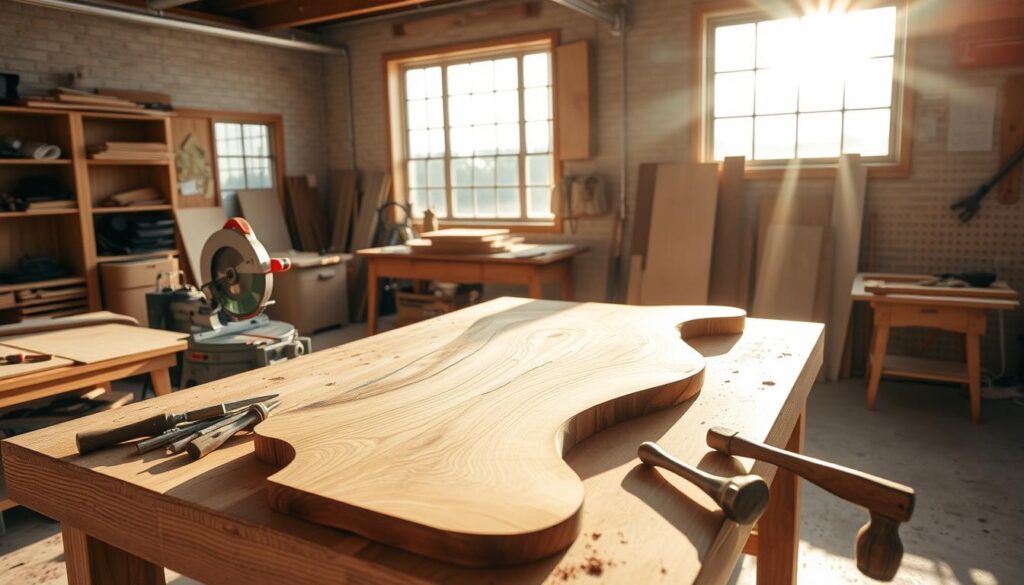
Measuring and Marking for Accurate Cuts
Begin construction by carefully measuring all your wood pieces according to your plan. Use a tape measure and square to ensure accuracy before making any cuts.
The fundamental rule “measure twice, cut once” prevents costly mistakes. Take your time during this critical step to verify all measurements.
When cutting boards, find the center and mark clear, visible lines. These lines will guide your saw blade for precision work.
Secure your wood pieces firmly using clamps before cutting. This prevents movement that could result in inaccurate or dangerous cuts.
For straight cuts, a circular saw with a guide produces clean, accurate results. Cut slowly and steadily to maintain control throughout the process.
If creating a tabletop from multiple boards, cut enough pieces to achieve your desired width. Ensure you have extra material to account for edge straightening later.
Proper preparation of your wood pieces sets the foundation for successful assembly. This careful approach leads to a professional-looking final product.
Step-by-Step Guide to Building Your Own DIY Coffee Table
This is where your vision starts taking physical form as you assemble the components into a cohesive whole. The careful planning and preparation now pay off in the assembly process.
You’ll follow a systematic method that professional crafters employ for quality results. Each phase builds logically upon the previous one, creating a smooth progression.
The approach breaks complex tasks into manageable actions. This makes the project accessible regardless of your experience level. Following the sequence ensures structural integrity and aesthetic appeal.
| Phase | Key Activities | Primary Tools | Outcome |
|---|---|---|---|
| Board Preparation | Straightening edges, joining pieces | Biscuit joiner, clamps | Flat, stable surface |
| Top Shaping | Cutting curves, refining edges | Jigsaw, router | Finished tabletop shape |
| Base Construction | Building legs, adding support | Circular saw, glue | Sturdy foundation |
| Final Assembly | Joining top to base, alignment | Clamps, level | Complete furniture piece |
Your finished piece will demonstrate proper joinery techniques and stability. The methodical process guarantees a durable result that matches your design specifications perfectly.
Straightening Edges and Joining Boards
Creating flawless joints between boards requires careful preparation and specialized techniques. This phase focuses on transforming individual wood pieces into a unified surface for your furniture project.
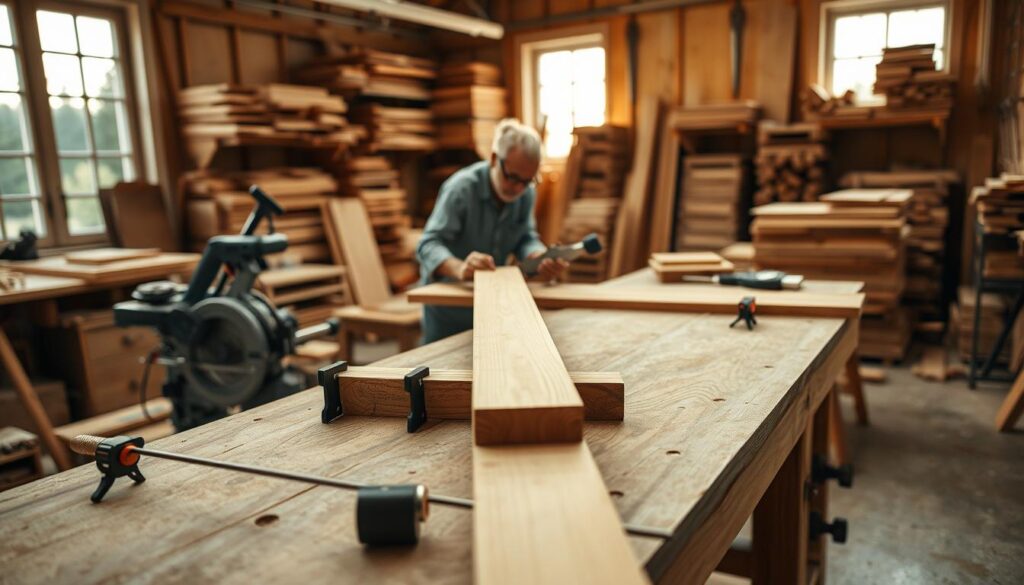
Using a Biscuit Joiner and Kreg Accu Cut for Precision
Begin by establishing perfectly straight edges on your boards. Any gaps or irregularities will weaken the joint and create visible flaws. Use the Kreg Accu Cut with your circular saw to ensure true, straight cuts.
Mark matching lines across both boards where you’ll place the biscuits. Space them approximately 6-8 inches apart for optimal strength. The biscuit joiner cuts slots in the mating edges, creating alignment guides.
Applying Wood Glue and Clamping Techniques
Apply wood glue generously to both the board edges and inside the biscuit slots. Work efficiently since the adhesive begins setting up within minutes. Insert the football-shaped biscuits into one board’s slots.
Slide the mating piece’s biscuits into their corresponding slots. The biscuits help align the boards perfectly during clamping. This prevents sliding out of position, which is crucial for wide surfaces.
Clamp your assembled boards with even pressure across the entire joint. Alternate clamps above and below to prevent bowing. Allow the glue to dry overnight for maximum strength before proceeding.
Shaping the Tabletop and Creating Curved Edges
Transforming straight edges into elegant curves elevates your furniture piece from functional to artistic. This phase focuses on creating the distinctive silhouette that gives your coffee table its unique character.
Drawing Templates and Marking Curved Lines
Begin by creating smooth, consistent arcs using flexible template material. Leftover stud shimming strips or thin plywood work perfectly for drawing accurate curved lines.
Secure your template with temporary screws while tracing the desired shape. Household items like jars create perfect smaller curves for base pieces. Mark clearly visible cutting lines that guide your subsequent work.
Cutting with a Jigsaw and Refining the Curves
Make your initial cuts with a jigsaw, staying just outside the marked lines. This conservative approach preserves material for final shaping. It prevents accidentally removing too much wood.
Refine the curved edges using a belt sander, working carefully to your original marks. Check frequently for symmetry between both ends. This attention to detail ensures professional-looking results.
Flip the tabletop upside down to add a chamfered edge using a palm router. This finishing touch creates a refined look while eliminating sharp corners. The way you handle these final details significantly impacts the overall aesthetic.
Your curved edges now transition smoothly from the flat tabletop surface. This elegant shaping gives your coffee table a sophisticated appearance that elevates it beyond basic furniture.
Building the Base and Adding Stability
The base structure provides essential support that determines the overall stability and longevity of your creation. This phase focuses on constructing a foundation that keeps your furniture secure and level through proper assembly techniques.
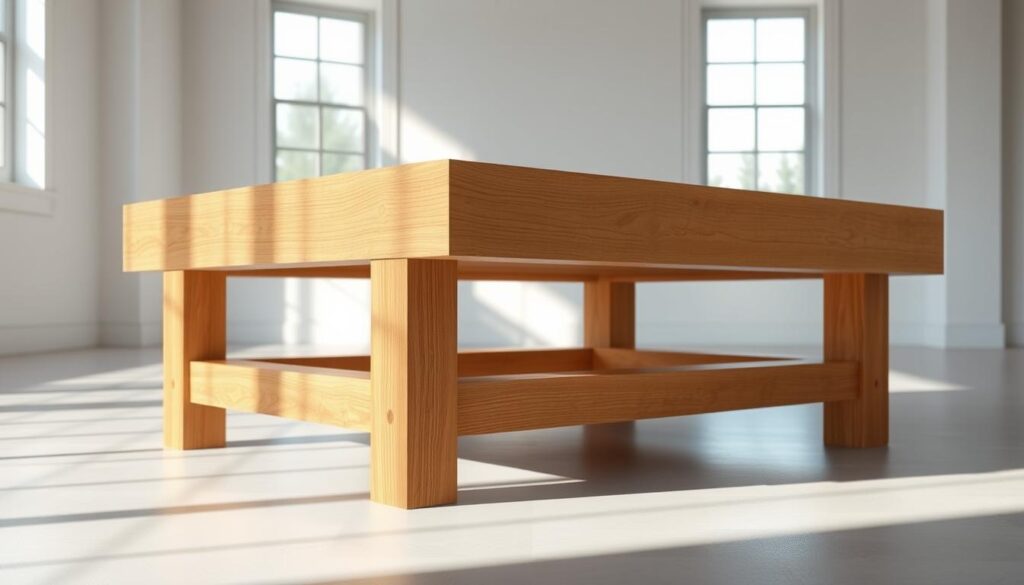
Cutting and Gluing Plywood Strips
Begin by cutting 2.5-inch wide strips from maple plywood using your table saw. Create enough pieces to achieve your desired height when stacked together. Work in manageable batches of three strips at a time.
Apply wood glue between each layer and clamp the assembly securely. This approach accommodates tool limitations while ensuring strong bonds. Mark precise locations where the tabletop will rest.
Use a band saw to create curved elements and cut recesses for the top to sit in. These careful cuts ensure the tabletop remains securely in place.
Incorporating a Center Brace for Structural Support
A center brace connects the two base ends, preventing shifting over time. Create this component by ripping leftover plywood and gluing two pieces together for added thickness.
Cut matching recesses in each base using a Japanese pull saw. Make multiple close cuts, then remove waste material with a hammer and chisel. Smooth the interior surfaces with sandpaper wrapped around a block.
This reinforcement system ties the entire structure together. Proper installation ensures your coffee table supports weight without wobbling.
Sanding and Finishing Techniques
The final transformation of your project begins with proper surface preparation. This phase elevates raw construction into a polished piece that showcases your craftsmanship.
Begin with coarse 80-grit sandpaper to remove imperfections and flatten surfaces. Work systematically across all areas of your furniture piece. Progress to 120-grit for smoother results.
Choosing the Right Grits for Smoothing
Your grit selection determines the final surface quality. Start aggressive and work toward refinement. Each stage prepares the wood for better finish absorption.
| Grit Number | Primary Purpose | Tool Recommendation | Surface Result |
|---|---|---|---|
| 80 | Remove flaws, flatten surfaces | Belt sander | Rough but even |
| 120 | Smooth scratches, prepare for finish | Belt/orbital sander | Medium smooth |
| 180 | Final preparation, ultra-smooth | Orbital sander | Finish-ready |
Complete your sanding with 180-grit paper for a perfectly smooth surface. This progression eliminates visible scratch marks.
Applying a Clear or Water-Based Finish for a Professional Look
Water-based finishes require special preparation. Wipe the surface with a damp cloth to raise the grain. After drying, sand lightly for a flawless final look.
Products like High Performance Satin by General Finishes dry crystal clear. They preserve natural wood color without yellowing. Apply three thin coats for optimal protection.
For stained projects, follow manufacturer instructions for application time. Multiple thin coats create a rich, durable finish. Your careful work results in a beautiful, long-lasting piece.
Assembling and Aligning the Complete Table
Final assembly represents the culmination of your woodworking efforts, where precision alignment determines success. This phase brings together all the carefully crafted components into a unified whole.
Begin by dry-fitting all elements before permanent attachment. Check that the tabletop sits evenly on the base structure. This test run prevents alignment issues during final assembly.
Fitting the Tabletop onto the Base Accurately
Use corner clamps to hold the base components securely in place. This ensures everything remains square while you work. Position the finished tabletop carefully onto the assembled base.
Drive wood screws from underneath the base into the tabletop. Make sure each connection point is tight and secure. Check that your completed piece sits perfectly level on the floor.
Install felt pads on the bottom of all legs to protect your flooring. These small additions prevent scratches and reduce sliding. Your beautiful furniture creation is now ready for use.
Step back and admire your finished work. This functional piece showcases your skills and personal design choices. It stands as a testament to your craftsmanship and attention to detail.
Creative Tips, Tricks, and Design Inspirations
Your completed coffee table is a blank canvas, ready for personal touches that reflect your unique taste. This final stage lets you explore endless coffee table ideas to make the piece truly yours.
Moving beyond the basic build opens up a world of customization. You can adapt the core design to fit any living room aesthetic.
Ideas for Customizing Your Coffee Table Style
Consider adding functional elements like a hidden storage compartment or a lower shelf. These features increase utility without sacrificing style. A great way to personalize your diy coffee project is to experiment with finishes.
Distressed paint creates a farmhouse feel, while a clear coat highlights natural wood grain for a modern look. The standard height of 16 to 18 inches works for most sofas, but you can adjust it.
Taller table ideas, around 24 inches, are perfect for incorporating flip-top storage. These projects offer both form and function.
How to Adapt the Design for Various Living Room Aesthetics
Your design choices should harmonize with your room‘s decor. For a rustic feel, use reclaimed wood and a weathered finish. Sleek hardwoods like oak with a simple clear coat achieve a minimalist aesthetic.
Industrial table ideas often mix materials, pairing a wood top with metal pipe legs. This creates visual interest and a contemporary edge.
Looking at existing plans is a great way to start your diy projects. Feel free to modify the plan by combining features from different coffee table ideas.
| Design Variation | Key Features | Typical Dimensions (Inches) |
|---|---|---|
| Modern Farmhouse | Distressed finish, simple lines | 43.5L x 33W x 17.75H |
| Ultimate Gaming Table | Built-in compartments for pieces | 36L x 24W x 17.75H |
| Industrial X-Leg | Wood top, iron pipe base | 47L x 22W x 17.25H |
| Hidden Storage | Flip-top lid, increased height | 48L x 24W x 24H |
Your creativity is the only limit. These table ideas provide a springboard for your own unique diy coffee table design.
Conclusion
This journey from a simple plan to a finished piece of furniture has equipped you with more than just a new coffee table. You now possess practical skills and the confidence to tackle future diy projects.
If you ‘re new to woodworking, this experience proves that complex tasks become manageable when broken down. The entire project, taking about 10 hours, is a great way to learn patience and precision.
Your completed piece is a testament to your effort. It enhances your living space and serves as a reminder of what you can achieve. This is a rewarding way to create personalized items for your home.
Every step in the process, from selecting the right material to final assembly, contributes to a durable and beautiful result. Enjoy the unique coffee table you built for your area.