

Surprising fact: a well-designed living room surface can cut visual clutter by over 40% and change how you use the room.
You’ll build a sturdy piece sized around 23.75″ x 46″ using two 12″ x 48″ pine project panels glued for the top. Soften the edge with a 3/8″ roundover for a furniture-grade feel, and fasten the top from below so no screws mar the finish.
Choose between twin full-width drawers or a hinged-lid chest with torsion hinges. Use 3/4″ plywood for the carcass, 1/2″ for box sides, and 1/4″ for bottoms to balance weight and cost.
Core tools include a pocket-hole jig, router with roundover bit, table saw, miter saw, brad nailer, and clamps. Mill laminated legs and stretchers, assemble a square frame, add a centered cubby or lid, then fit slides and faces for clean 1/8″ reveals.
Key Takeaways
- Size and top: 23.75″ x 46″ top, 3/8″ roundover, hidden fasteners.
- Storage options: twin drawers or hinged-lid chest with torsion hinges.
- Material choices: 3/4″, 1/2″, and 1/4″ plywood for optimal strength and cost.
- Essential tools: pocket-hole jig, router, saws, brad nailer, sander, clamps.
- Finish tips: stain plus water-based poly or mixed finishes for contrast.
Why build a DIY coffee table with storage right now
Tackling this build now gives you a quick way to reclaim the living room and add usable surface area. You gain instant clutter control by putting remotes, blankets, toys, and magazines into a single, neat box under the top.
Choose a hinged lid with torsion hinges and you get slow, safe opening that holds the lid at any angle. That makes access quick and prevents slamming when you grab a blanket or toy.
Alternatively, two drawer bays using standard 1/2″-thick side-mount slides and 1/8″ face gaps deliver a refined look and organized compartments. The result feels premium and works every day.
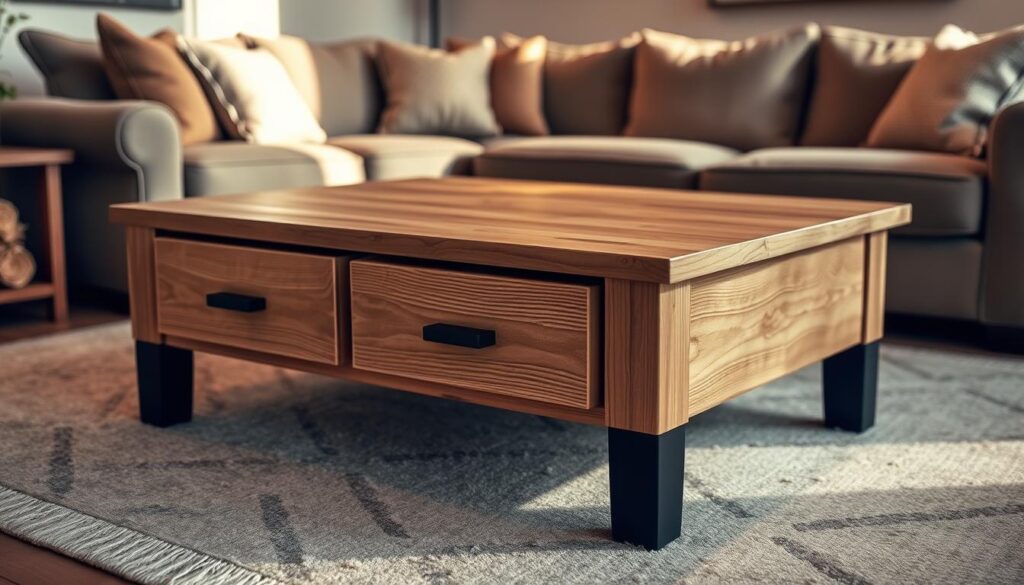
Assembly is also faster than you think. Pocket holes let you attach stretchers and carcass parts squarely in a single step. This project fits a weekend build and uses common plywood and simple tools you likely already own.
- Customize capacity: size the cavity or drawers to fit the exact place between sofa and TV stand.
- Save money: get furniture-grade details—edge banding and consistent reveals—at a fraction of retail cost.
- Learn skills: accurate pocket-hole layout, slide installation, and face fitting transfer to future builds.
Materials, lumber, and tools you’ll need for this project
Confirm your parts list before you cut anything. Inspect every sheet and board for straightness and defects. This saves time and keeps the final fit tight.
Essential tools
Core kit: pocket hole jig, drill, table saw, miter saw, circular saw, jigsaw, router with 3/8″ roundover bit, 18-gauge brad nailer, sander, and plenty of clamps.
Use the pocket jig for fast, repeatable joins and the router for profiles or hinge mortises if you choose a hinged option.

Lumber and hardware
Gather 3/4″ plywood for the carcass, 1/2″ for drawer sides, and 1/4″ for drawer bottoms. Add straight 1x boards for legs and stretchers and two 12″x48″ pine panels for the top.
Stock drawer slides, pulls, furniture angle brackets, wood glue, wood filler, edge banding, and molding. Keep 1.25″ pocket screws and brad nails handy for assembly.
| Item | Recommended Size | Purpose | Notes |
|---|---|---|---|
| 3/4″ plywood | 4×4 sheet | Carcass structure | Holds screws well |
| 1/2″ plywood | 2×4 sheet | Drawer sides | Lightweight, strong |
| 1/4″ plywood | 2×4 sheet | Drawer bottom | Reduce weight |
| Solid boards | 1×6, 1×8 | Legs & stretchers | Rip to final size before assembly |
DIY Coffee Table With Drawers: Storage Solutions That Look Great — plans, cuts, and layout
Start by locking in final overall dimensions so every cut lines up and the frame assembles square.

Final dimensions, overhang, and stretcher spacing
Confirm your final top size near 23.75″ x 46″. Plan a uniform 1/2″ overhang on every side by calculating stretcher lengths before cutting.
Set short stretcher lengths to about 17 5/8″ and long ones to roughly 39 7/8″ under the top. Rip and laminate boards for legs to about 2.5″ x 2.5″ and cut all four together so the piece sits level.
Chamfer the feet at 45° and finish legs to ~17.25″ height. Mark the bottom stretcher about 3″ up from the foot to allow room for a shelf or decorative edge.
Storage configuration: twin drawers, center cubby, or hinged-lid compartment
Decide early which way you’ll configure the inside. Each option affects divider and back panel placement.
- Twin drawers: install a center front divider ~6 3/8″ from the bottom to split the opening. Allow slide thickness so the faces keep a 1/8″ reveal.
- Center cubby: lay out long and short stretchers on the bench to visualize clearances and box size before fastening.
- Hinged-lid option: build a 3/4″ plywood box carcass, edge-band exposed top edges, and route 1/2″ mortises so torsion hinges sit flush on the 3/4″ thickness.
“Dry-fit every board and piece on the surface first; this saves time and prevents alignment surprises during final assembly.”
Use pocket holes on stretcher ends and pocket-screw the back panel in non-visible places. Pre-plan screw locations so faces remain clean and exact.
Build the frame and top for a strong, square table
Start by squaring your parts so every joint meets cleanly and the frame stays true. Rip the rounded factory edges off your boards, then mill strips: 1×6 into 2.5″ and 1.75″ pieces, and the 1×8 into 1.5″ strips.

Ripping and laminating legs, cutting long and short stretchers
Laminate a 1.75″ plus a 2.5″ strip to form legs approximately 2.5″ x 2.5″. Glue and clamp each lamination, then brad-nail temporarily. Cut all four legs to 17.25″ together to prevent rocking.
Assembling side panels and setting lower stretcher height
Drill two pocket holes in each end of both short (~17 5/8″) and long (~39 7/8″) stretchers for 3/4″ stock. Mark 3″ up from the leg bottoms for the lower stretcher.
Assemble each side flat on the bench. Align the top stretcher flush to the leg top, set the lower stretcher at the 3″ mark, then check diagonals to confirm square.
Gluing up the top, trimming to size, and adding a roundover profile
Glue the two 12″ x 48″ project panels together and clamp across and along the length for even pressure. Trim the glue-up to 23.75″ x 46″ for a 1/2″ overhang.
Route a 3/8″ roundover on the top perimeter. Make a light second pass to clean any tear-out, then dry-fit the top to confirm uniform overhang and proper alignment with the stretchers and leg faces.
| Step | Dimension | Purpose | Notes |
|---|---|---|---|
| Leg lamination | 1.75″ + 2.5″ | Create 2.5″x2.5″ legs | Clamp, glue, brad-nail while drying |
| Short stretcher | 17 5/8″ | Side support | 2 pocket holes per end for 3/4″ stock |
| Long stretcher | 39 7/8″ | Front/back support | Mark ends; assemble to sides in stages |
| Top glue-up | Trim to 23.75″x46″ | Finished top edge & overhang | Route 3/8″ roundover; dry-fit before final fastening |
Add the lower shelf and trim for a clean, finished underside
Start by marking the cleat line under the lower stretchers. Hold a scrap of 3/4″ plywood tight to the stretcher top and scribe a consistent line. This gauge sets the shelf depth so the bottom panel sits perfectly flush.

Using cove molding as a hidden cleat
Cut cove molding to fit inside the frame and miter each corner. Dry-fit every piece and trim slightly long to sneak up on a clean joint. Apply glue to mitered edges before final assembly so corners close tightly.
Gluing, clamping, and nailing techniques
Glue below the marked line, then pin the cove molding with 1″ brads to hold the cleat in place. Run a generous bead of glue in the channel; drop the plywood shelf into the glue bead so adhesive squeezes to both faces.
Draw center stretchers into the shelf with clamps so the panel seats flat. Finish by shooting a couple of 1.5″ brads at an angle into each corner through the trim and into the leg to lock it while glue cures.
| Task | Material | Fastener | Why it matters |
|---|---|---|---|
| Mark cleat line | 3/4″ plywood scrap | pencil | Ensures shelf sits flush at the correct bottom height |
| Hidden cleat | cove molding | 1″ brads | Conceals holes and keeps underside clean |
| Secure shelf | plywood panel | 1.5″ angled brads | Locks corners and holds while glue cures |
Build the center drawer cubby and front divider
Lay out the cubby sides and mark notches so the interior panels fit snugly against the stretchers. Cut two 3/4″ plywood side panels to about 22 5/8″ x 14 1/4″. Use a stretcher offcut as a gauge and trim the top corners with a jigsaw so the panels seat cleanly.
Place one pocket hole at each notch and drill four along the interior bottom of each panel. Edge band the front and back edges before installation so exposed faces read finished when the piece is assembled.
Notching, pocket-hole placement, and edge work
Mark consistent insets of roughly 14.5″ from each outer side and transfer those lines to the top stretchers. Glue the panels in place and secure them with pocket screws into the lower and top stretchers, checking for plumb as you go.
Back panel, center divider, and tapered molding
Cut and install a back panel edged with pocket holes and one hole at the bottom; tack the top into the stretcher with brads until glue cures. Fit the front center divider — a simple board set about 6 3/8″ up from the bottom — to split the opening for two equal drawer faces.
Finish the rear opening with tapered molding, mitered like a picture frame. Glue and pin with 5/8″ brads, then lightly sand banded edges so the inside matches the exterior finish and the drawer boxes will slide without rubbing.
| Part | Size / Fasteners | Why |
|---|---|---|
| Side panels | 22 5/8″ x 14 1/4″ / pocket holes | Fits under stretchers, hides fasteners |
| Back panel | plywood / pocket holes + brads | Secures cubby and supports molding |
| Center divider | 1×2 board / glue + brad | Splits opening for two drawer fronts |
Drawer boxes, slides, and face fitting
Start by measuring the clear opening so your drawer box width is correct. Use the standard formula: drawer box width = opening width – 2 × slide thickness. For common 1/2″ side-mount slides, subtract 1″ total.
Measure, cut, and assemble the boxes
Rip 1/2″ plywood to 4″ tall for the sides. Cut side pieces (about 19″) and front/back pieces (about 12 5/8″) after you verify your opening and slide specs.
Assemble with the front and back captured inside the sides. Apply glue, then use 1.5″ brads to nail the joints. Check diagonals and square the box before adding the 1/4″ bottom.
Bottom panel, nails, and edge banding
Slide the 1/4″ bottom into the groove or seat it inside the rabbet. Run a thin bead of glue along the bottom edge and pin every ~4″ with 5/8″ brads.
Band the top edges of the sides for a clean finish or leave them exposed for a shop look; either way the function is the same.
Install slides and set reveals
Mount the cabinet members in the carcass: shim the lower slide 1/4″ up from the bottom. Use a 6 1/4″ spacer to position the upper slide for consistent vertical spacing.
Attach the drawer members to the boxes with the provided screws. Test the travel and tweak mounting holes so movement is smooth and stops align at each end.
Fit false fronts and final adjustment
Cut false fronts from a 1×6 picket and fit them to a uniform 1/8″ reveal on all sides. Hold the face in place with temporary screws from inside the box while you check the gap.
- Pre-drill pull holes and back up the face with a block to avoid blowout.
- Tweak slide positions if one drawer sits proud or low.
Edge banding, sanding, and finishing for furniture-grade results
Finish work is what turns a solid build into furniture that feels polished and intentional. Start by banding all exposed plywood edges. Iron-on banding hides the layers and gives a clean face for your final coats.
Trim the edge banding flush with a dedicated trimmer. Lightly file or sand any raised seams so corners read smooth.
Prepare surfaces and fill fastener marks
Fill brad nail and nails marks with a water-based filler and overfill slightly. Sand those spots flat to avoid low areas showing through your finish.
Sand broad faces starting at 120 grit and progress to 220 if you plan a higher-sheen coat. Wipe dust away with a damp rag before staining or sealing.
Choose a finish and follow a curing schedule
Stain first if you want color; use an example like Moorish Teak for a warm tone, then apply three coats of water-based polyurethane for fast dry times and low odor.
Alternatively, use oil-based products for deeper color or paint for a color-forward route. For drawer interiors, apply only a light clear coat to keep drawer slides moving freely and minimize odor transfer.
Final attachment and hinge prep
Align the top so overhangs are equal on every side. Secure the top from below with three furniture angle brackets along front and back. Use 1/2″ screws to avoid penetrating the surface.
If you built the hinged variant, route 1/2″ mortises for torsion hinges and pre-drill using a hinge jig and a self-centering bit before final hinge installation.
“Allow adequate time between coats for sanding and curing; keeping the schedule ensures a durable finish that feels smooth to the touch.”
| Task | Tool / Material | Why it matters |
|---|---|---|
| Edge banding | Iron-on banding, trimmer | Conceals plywood edge for furniture-grade look |
| Fill & sand | Wood filler, 120–220 grit | Removes visible holes and creates smooth surface |
| Final coat | Water-based poly (3 coats) or oil finish | Protects surface and gives desired sheen |
| Attach top | Furniture angle brackets, 1/2″ screws | Secures top without penetrating or splitting |
Popular variations and upgrades
If you want a single large compartment, a hinged lid gives a clean, accessible interior for blankets and game boxes.
Hinged-lid option: use torsion hinges to hold the lid position and prevent slamming. Route 1/2″ mortises into 3/4″ PureBond oak plywood and the lid so the hardware sits flush. This keeps the rear edge level and the opening smooth.
Alternate tops and feet
Swap in hardwood panels, breadboard ends, or reclaimed boards to change the look while keeping the same footprint. Match oak edge banding to the PureBond core for a premium read across exposed edges.
Add feet to lift the silhouette. Simple block feet bolt into the bottom or you can fit turned feet into threaded inserts for a refined option.
Custom molding profiles and fit tips
Route your own molding from solid oak or use off-the-shelf base cap. Use a 45-degree sled and a mitre jig for tight corners. For routed hinge mortises, a 1/2″ straight bit gives clean walls and consistent depth.
- Keep two full-width drawers if you prefer faces and 1/8″ reveals; upgrade to soft-close drawer slides for a refined feel.
- Build shallow trays for the top drawer to hold remotes and small items while leaving deep inside space for bulky pieces.
- Watch short setup video clips for hinge and mitre techniques; a dedicated sled saves time and improves accuracy.
| Upgrade | Key action | Why it helps |
|---|---|---|
| Hinged lid | Install torsion hinges, route 1/2″ mortises | Quiet, held-open lid and flush fit at back edge |
| Alternate top | Swap hardwood or reclaimed board | Changes aesthetic without new plans |
| Feet option | Add block or turned feet, secure with inserts | Elevates silhouette and protects floor |
| Molding profiles | Route custom trim or use base cap | Tight miters and solid joints read as furniture-grade |
Conclusion
Finish the build by checking reveals and securing the top. Align a 1/2″ overhang all around, confirm 1/8″ gaps on each drawer face, then fasten the top from below using interior angle brackets for a clean surface.
For the hinged variant, pre-drill hinge locations with a jig and a self-centering bit so torsion hardware sits true and the lid opens smoothly. Clamp before you screw to prevent movement.
Take one final pass on edge sanding and the finish coat. Test each slide and the side fits, and address any pocket hole or hole tear-out before the last coat cures.
If you have questions, note them now and tackle the most important one first. Enjoy the thing you made; this project gives a useful, well-finished coffee table you can place and use every day.